 TILTSYNC
TILTSYNC
TILTSYNC
The easiest way to align solar panels. Perfect for DIYers and beginners — no experience required.
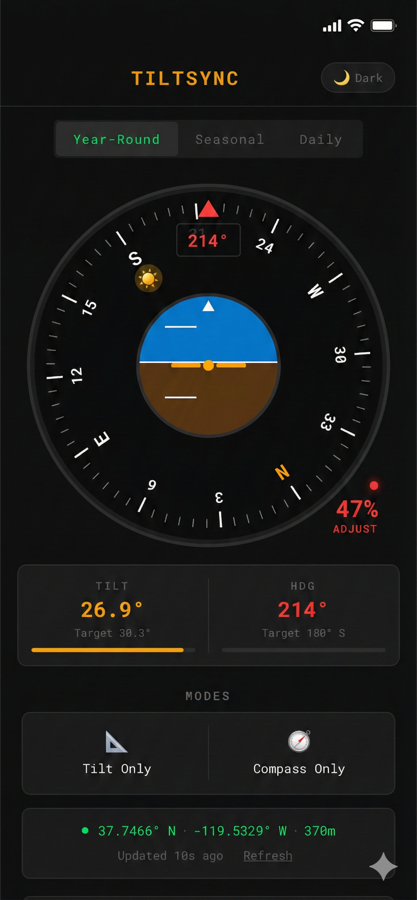
Intuitive display with rotating compass, tilt indicator, and real-time digital readouts. Not just functional — beautiful to use.
Progressive vibration feedback intensifies as you approach perfect alignment. Feel your way to the target without watching the screen.
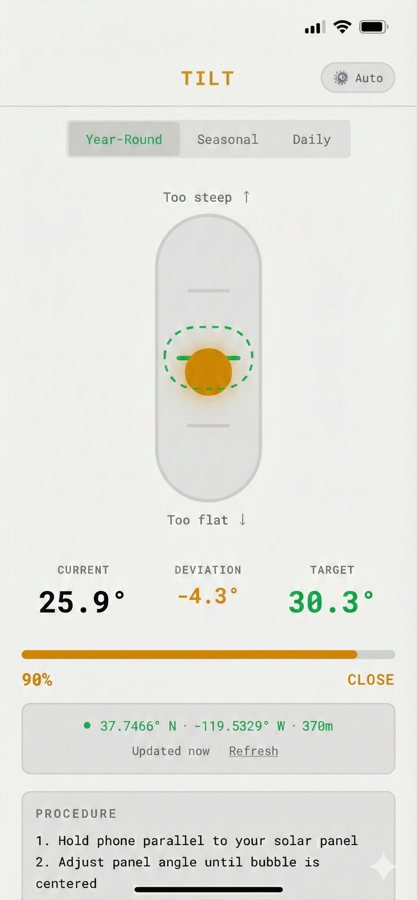
Align both tilt angle and compass direction in one view. Or use dedicated modes for tilt-only and compass-only alignment.
Automatically calculates optimal angles based on your exact latitude. Cached location means instant startup on return visits.
Dark mode for indoor prep, light mode for outdoor visibility. Auto mode follows your system preference.
All calculations happen on-device. No account required, no data collected. Just open and align.
Enable industry-standard calculations from NREL's PVWatts API. Uses your approximate location (~1km precision) to query real solar data.
Choose from Simple Latitude, Energy Optimized, Landau, Jacobson, PVWatts estimate, or live NREL data. Compare tilt angles side-by-side.
Best fixed angle for maximum annual energy production. Ideal for permanent rooftop installations.
Choose from 6 different formulas
Optimized angles for summer and winter. For adjustable mounts that can squeeze extra efficiency.
Base angle uses your selected formula
Updates every minute based on current sun position. Perfect for portable panels, camping, and RV setups.
Sun position calculated from date, time & location
TiltSync offers six different methods to calculate optimal tilt. Compare them side-by-side and choose what works best for you.
The traditional rule of thumb: set your panel tilt equal to your latitude. Simple, widely taught, and provides a solid baseline for year-round production.
A slight reduction from the simple rule. Accounts for diffuse radiation (scattered sunlight) which is captured better at lower angles. Often produces more total annual energy.
Empirically derived formula from solar energy research by Charles R. Landau. Optimized for maximum annual energy yield based on iterative calculations of over 12,000 data points per configuration.
Third-order polynomial curve fit derived by Stanford researchers Jacobson & Jadhav from PVWatts simulation data. Better matches optimal tilt above 40° latitude than linear formulas.
Local approximation of the NREL PVWatts model used by solar professionals. A good balance between simplicity and real-world optimization. Works offline.
Real-time calculation from the National Renewable Energy Laboratory. Uses actual solar irradiance data for your location. The industry standard used by professional installers.
Which should I use? For most fixed installations, any formula will get you within a few degrees of optimal. The difference in annual energy production between formulas is typically 1-3%. If you want the most accurate result for your specific location, enable PVWatts Live in Settings.
Formula is used directly. Your selected calculation determines the fixed optimal angle for maximum annual production.
Formula provides the base angle, then ±15° is applied based on season. Summer tilts lower, winter tilts higher.
Formula is not used. Tilt is calculated from the sun's current position (90° minus solar altitude), updating every minute.
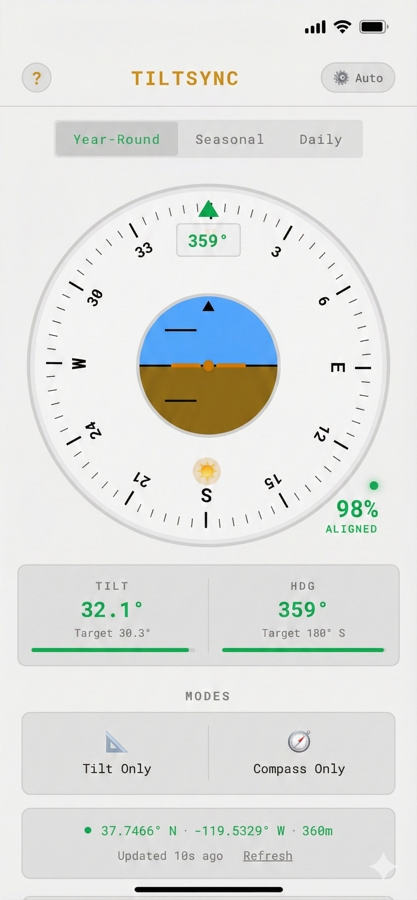
Combined dashboard
Bubble level
Light mode
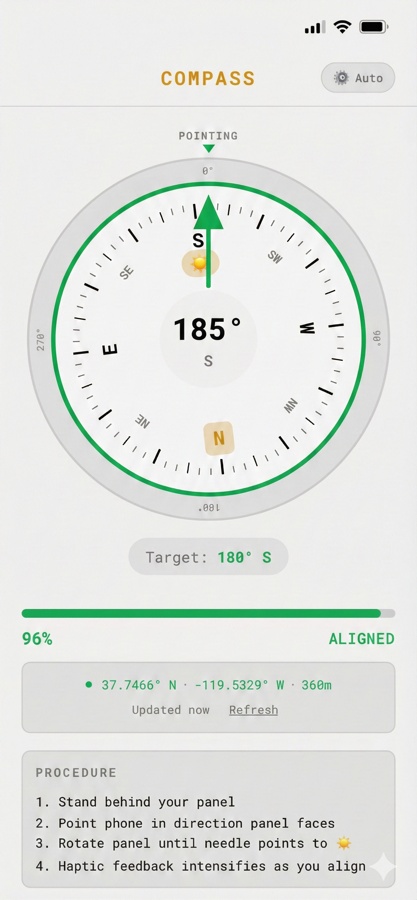
Compass mode
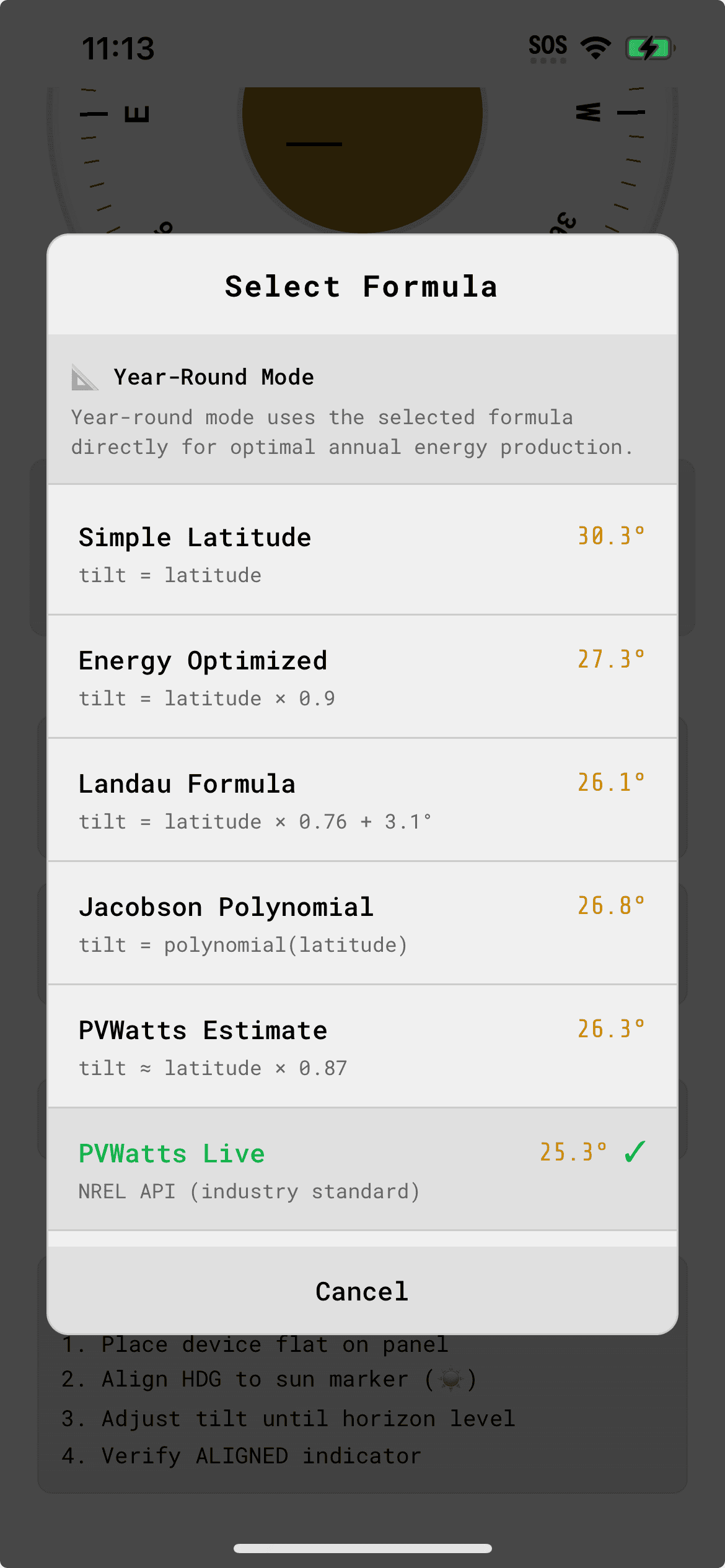
Formula picker
TiltSync for Android is ready — but we need your help to go live. Google Play requires new apps to have 12 beta testers for 14 days before publishing.
Google Play's new testing policy requires personal developer accounts to run a closed test with at least 12 opted-in testers for 14 consecutive days before publishing to production. This helps ensure app quality on the Play Store.
Want early access? Email me and I'll add you to the beta. You'll get TiltSync for Android before anyone else.
Request Beta Access